

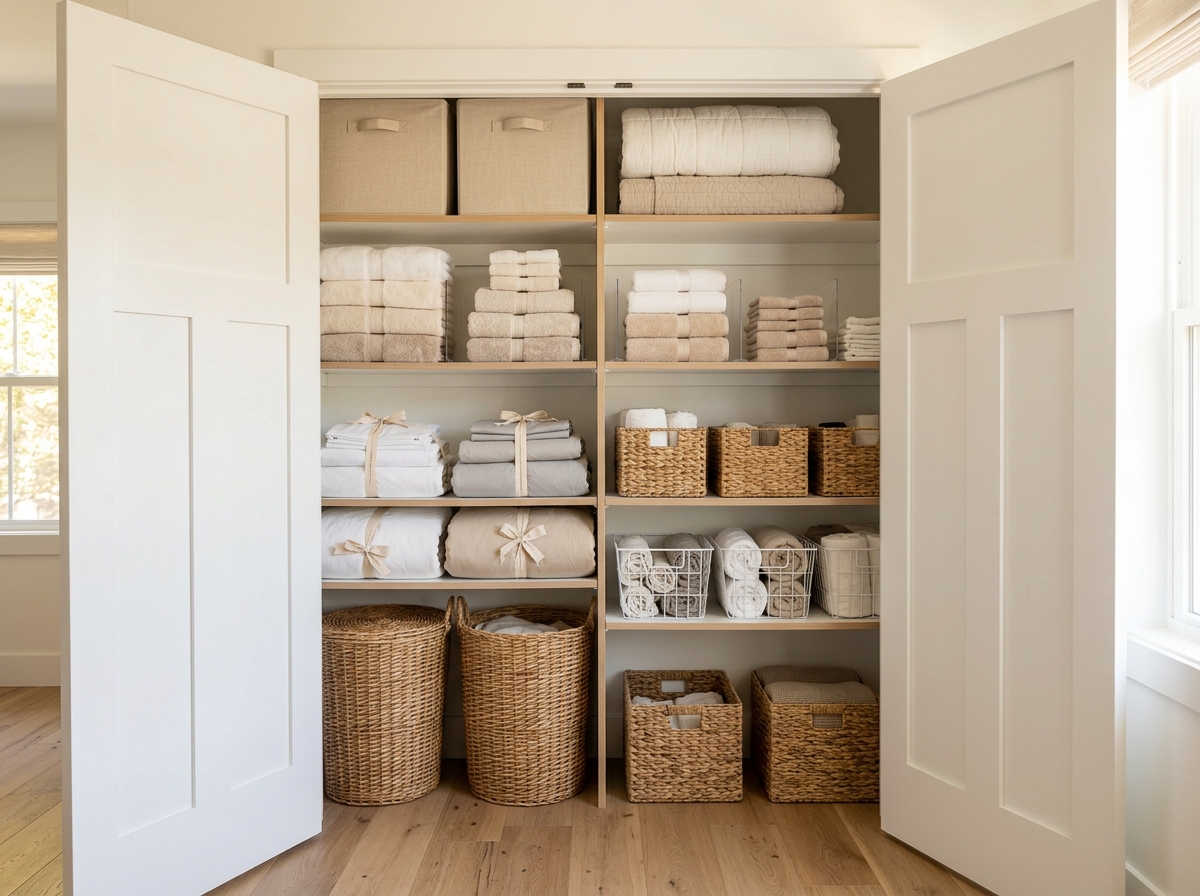
Most linen closets fail for a simple reason: the shelves are sized for towels, but the contents rarely stay in neat, matching stacks. Pillowcases migrate to the back, duvet covers swallow half a shelf, and the moment you need a clean set, you’re pulling everything out just to find the fitted sheet. Organizing this space effectively starts with knowing what you’re actually storing — and if bedding is part of the mix, the measurements of standard pillow sizes //pillowshowcase.com/pillow-faq-guides/pillow-size-and-dimensions-chart/ are a useful reference for figuring out how much shelf depth and height pillowcases and pillows will consume. Once you know the dimensions you’re working with, the rest of the closet falls into place.
Quick Answer
The most effective linen closet systems sort by category and frequency of use rather than by matching sets. Store everyday towels and sheets at eye level, bulky or seasonal items on the top shelf, and use vertical dividers or labeled bins to stop stacks from collapsing. Keeping one complete set inside its matching pillowcase is the single hardest-working trick in the entire closet.
Key Takeaways
- Group linens by category first, then by how often you use them — not by matching color or pattern.
- Storage height should match weight and frequency: heavy items low, light and bulky items high, daily items at eye level.
- The “bundle inside the pillowcase” method keeps sheet sets together and eliminates mid-search pile-ups.
- Measure shelf depth and the folded height of your linens before buying bins or dividers, since mismatched containers waste more space than they save.
- Humidity and dust are the two silent enemies of stored linens; a closet that stays dry and closed does more for freshness than any scented sachet.
Start With an Honest Inventory, Not a Shopping Trip
The instinct to buy organizers before knowing what’s inside the closet is the most common mistake. Empty everything onto a bed or floor and sort into four piles: sheets, pillowcases, towels, and items you no longer use. That last pile is usually larger than expected. A linen closet with three unmatched flat sheets and a dozen hotel-logo towels isn’t disorganized — it’s overfilled.
Once you’ve separated the keep pile, count it. Knowing you have four sheet sets and six bath towels is what determines how many dividers, bins, or shelf risers you actually need. This step takes fifteen minutes and prevents buying containers that don’t fit either the shelf or the contents.
How Should You Decide What Goes Where?
Assign shelving based on two variables: how often you reach for something and how heavy it is. This is the logic professional organizers use, and it works because it matches the physical reality of a closet rather than an aesthetic ideal.
- Top shelf: bulky seasonal items — winter blankets, extra comforters, guest bedding.
- Eye level: items used weekly — everyday towels, current sheet sets, hand towels.
- Below eye level: moderately used items and overflow — spare pillowcases, table linens.
- Floor or bottom shelf: heavy or rarely used items — beach towels, large blankets, storage bins.
The reason heavy items belong low is straightforward: reaching above shoulder height for a dense stack of blankets is how people get hurt. The reason daily items belong at eye level is equally practical — anything you grab frequently should not require a stool or a crouch.
The Trick That Fixes the Sheet-Set Problem
Few things derail a linen closet faster than a fitted sheet with no matching flat sheet. The simplest solution is to fold the entire set, then slide it inside one of its own pillowcases. The case becomes a tidy bundle that holds every piece together, and when you pull one out, you have a complete set with no searching.
This method works best when the pillowcase is a standard or queen size, since a folded set needs a bit of room to slide in cleanly. If you’re unsure whether your cases will hold a full set, a quick look at common sizing helps you plan before you start folding. Bundles stack more evenly than loose sheets, which means you’ll fit more on a single shelf without the pile leaning sideways.
How to fold a bundle that actually stays flat
- Fold the fitted sheet into a rectangle, tucking the elastic corners inward so it lies flat.
- Fold the flat sheet to the same width.
- Stack the fitted sheet, flat sheet, and one pillowcase together, then fold the group in half.
- Slide the whole stack into the second pillowcase, folding the open edge under itself.
Label the shelf by size, not by color, if you store multiple bed sizes. It saves time when someone in the house needs a spare set in a hurry.
Dividers, Bins, and When They Help — and When They Hurt
Vertical dividers are genuinely useful for separating sheet bundles, keeping them upright so you can see every set at a glance. Open bins work well for items that don’t stack neatly, such as washcloths, hand towels, and small guest toiletries. What rarely helps are deep, opaque containers that hide their contents, because you end up digging through them exactly the way you dug through the loose piles you replaced.
| Storage Tool | Best For | Watch Out For |
|---|---|---|
| Vertical shelf dividers | Sheet bundles, folded towels | Need shelf depth to match bundle width |
| Open-front bins | Washcloths, small linens | Can collect dust in humid rooms |
| Stackable baskets | Guest bedding, seasonal sets | Heavy when full; keep them low |
| Clear zippered bags | Off-season items, protection | Traps moisture if linens aren’t fully dry |
Notice the pattern: every tool in that table has a specific job. If a container doesn’t match a category you actually have, it becomes clutter with a lid.
Protecting Linens From Dust, Damp, and Mustiness
Linen closets are often built into hallways or bathrooms, which means humidity swings. Damp linens develop a musty smell that no amount of folding fixes. The practical defenses are simple: never store linens until they are completely dry, keep the closet door closed to limit dust, and avoid cramming items so tightly that air can’t circulate.
Cedar blocks, charcoal pouches, or unscented moisture absorbers can help in genuinely humid environments, but they don’t replace the basic practice of storing only dry fabric in a ventilated space. Scented sachets mask odor rather than prevent it, and some people find the fragrance transfers to bedding over time.
Maintaining the System So It Doesn’t Collapse
An organized closet degrades the moment new items come in without a home. The simplest maintenance rule is one-in, one-out: when a new sheet set arrives, an old one leaves. Pair that with a two-minute reset after each laundry cycle, returning folded linens to their assigned shelf, and the system holds up far longer than a one-time deep clean.
Review the closet once a season. Seasonal shifts are natural moments to move heavy blankets down and light throws up, or to retire worn items. This rhythm prevents the slow refilling that turns a tidy closet back into a pile in a few months.
Frequently Asked Questions
How do I keep fitted sheets from unravelling in the closet?
Fold the fitted sheet with the elastic corners tucked inward so it forms a flat rectangle, then bundle it inside its matching pillowcase. The case holds the shape and stops the corners from springing loose.
Is it better to store linens in bins or on open shelves?
Open shelves with dividers suit items you use often, since you can see and grab them easily. Bins work better for seasonal or guest linens that sit untouched for months, because they block dust.
How can I stop my linen closet from smelling musty?
Store only fully dry linens, keep the door closed to reduce moisture entry, and avoid packing shelves so tightly that air can’t move. In humid rooms, add a moisture absorber and check it regularly.
Should I organize by color or by category?
Category first, always. Color-coordinating looks tidy in photos but slows you down in practice. Grouping sheets, towels, and pillowcases separately means you find what you need without reshuffling the whole shelf.
How often should I reorganize a linen closet?
A quick reset after each laundry cycle, plus a fuller review once per season, is usually enough. Seasonal reviews are the natural time to swap heavy items for light ones and remove anything worn out.
Can I store linens in the bathroom?
It’s possible but not ideal. Bathrooms hold humidity from showers, which encourages mustiness. If there’s no alternative, use sealed bins and moisture absorbers, and rotate the linens more frequently.
Conclusion
A linen closet that works isn’t the one with the prettiest matching baskets — it’s the one where you can find a complete sheet set in ten seconds. Sort by category and frequency of use, keep heavy items low and daily items at eye level, and bundle complete sets inside their pillowcases to stop the classic pile-up. Add dividers only where they solve a real problem, protect everything from damp and dust, and do a quick seasonal review. The system takes an afternoon to set up and about two minutes a week to maintain.





Leave a Reply